
Testimonial.to helped popularize a simple idea: send customers one link, collect text or video praise, then embed that proof on your website. It is still a useful tool, but it is no longer the only serious option. Some teams need more affordable scaling, some need better design control, some want stronger video workflows, and others want a lightweight wall of love they can publish without touching code.
That is where alternatives become interesting. The best testimonial platform is not always the one with the longest feature list. It is the one that fits how you ask customers for feedback, how you organize that feedback internally, and where you need to display proof across your funnel.
In this guide, we will compare the 10 best Testimonial.to alternatives for building social proof in 2026. You will find a practical breakdown of each tool, screenshots, ideal use cases, tradeoffs to consider, and a quick decision framework to help you choose the right platform.
Why Look for a Testimonial.to Alternative?
Testimonial.to is popular for good reason. It makes collecting and displaying testimonials feel simple. But once testimonials become a real part of your marketing workflow, the details start to matter more.
Teams commonly look for alternatives for a few recurring reasons:
- Pricing. As your testimonial volume grows or you need more widgets and video minutes, costs can climb faster than expected.
- Display flexibility. Some teams want more control over how walls, sliders, and single-quote widgets look and match their brand.
- Video vs. text focus. A few tools specialize in high-quality video, while others are optimized for fast text collection.
- Ease of embedding. No-code embeds, WordPress plugins, and lightweight scripts matter if you're not a developer.
- Automation and integrations. Import from review sites, social platforms, and CRMs, or push testimonials into your existing stack.
- Team workflow. Approval flows, tagging, permissions, and reuse across campaigns become important as your library grows.
- Performance. Widgets should look good without slowing down the landing pages they are meant to improve.
Keep these trade-offs in mind as you read: the "best" tool is the one that matches how you actually collect and show social proof.
What to Look for in a Testimonial.to Alternative
Before comparing tools, it helps to know the criteria that actually matter. A testimonial platform should do more than store nice quotes. It should help you turn customer proof into a repeatable marketing asset.
1. Collection experience
The collection form should be easy for customers to complete without creating an account or reading a long set of instructions. Look for tools that support simple share links, guided prompts, optional video uploads, consent capture, and a clean mobile experience.
A great testimonial request flow removes friction. It should feel like replying to a friendly question, not filling out a support ticket.
2. Display options
Collecting testimonials is only half the job. The display layer is where social proof starts influencing conversions. Useful display options include:
- Wall of love pages
- Website carousels
- Grid layouts
- Single testimonial cards
- Video testimonial embeds
- Floating badges or popups
- Social image exports
The best option depends on placement. A pricing page might need short objection-handling quotes. A homepage might need a full wall of love. A product page might need testimonials filtered by use case.
3. Customization and branding
Your testimonial widget should look like part of your site, not a pasted-in third-party block. Check whether you can control colors, spacing, cards, avatars, logos, rating display, dark mode, and layout behavior.
This matters more than it seems. Social proof works because it feels credible. If the widget clashes with your site, visitors subconsciously treat it as an ad.
4. Video support
Video testimonials can be extremely persuasive, but they also introduce complexity. You may need recording flows, upload support, hosting, captions, transcripts, editing, permissions, and mobile-friendly playback.
If video is central to your strategy, choose a tool built around video. If you mostly need fast text quotes, a simpler text-first platform may be easier and more cost effective.
5. Importing and automation
Many teams already have proof scattered across Google reviews, LinkedIn posts, X/Twitter mentions, G2 reviews, support emails, Slack messages, and customer success calls. A good tool should help you centralize that proof instead of starting from zero.
Automation also matters. The more testimonial collection depends on someone remembering to follow up manually, the less consistent your results will be.
6. Pricing and scaling
Avoid evaluating pricing only by the starting plan. Instead, ask:
- What happens when you need more testimonials?
- Are video minutes limited?
- Are widgets, workspaces, or team seats limited?
- Can you remove branding?
- Do you need a higher tier for key features?
- Will the tool still make sense a year from now?
Pricing pages change often, so always confirm current details before choosing. For this guide, we focus on positioning and use cases rather than exact price comparisons.
Now, let's get into the list.
The 10 Best Testimonial.to Alternatives
Here is the short version before we go deep:
| Tool | Best fit | Main strength | Main tradeoff |
|---|---|---|---|
| ProofWall | Small teams, founders, marketers | Fast collection and no-code display widgets | Newer ecosystem than some older tools |
| Senja | Creators and SaaS teams | Polished widgets and social proof design | Advanced workflows may require paid tiers |
| Trustmary | Conversion-focused teams | Review collection plus optimization tools | Can feel broader than needed for simple testimonial walls |
| Famewall | Creators and indie products | Simple wall of love and social imports | Less enterprise-oriented |
| Shoutout | Straightforward testimonial workflows | Clean collect-and-embed process | Smaller brand footprint |
| Vocal Video | Video-first teams | Guided video collection and polished outputs | More focused on video than simple text proof |
| Boast | Service businesses and structured forms | Video/audio collection workflows | Interface can be more process-heavy |
| VideoAsk | Conversational video collection | Interactive video prompts | Not purpose-built only for testimonials |
| Endorsal | Automated testimonial requests | Hands-off collection workflows | Less known than newer creator-focused tools |
| Testimonial Hero | Premium B2B video | Done-for-you production quality | Service model, higher cost, less self-serve |
1. ProofWall
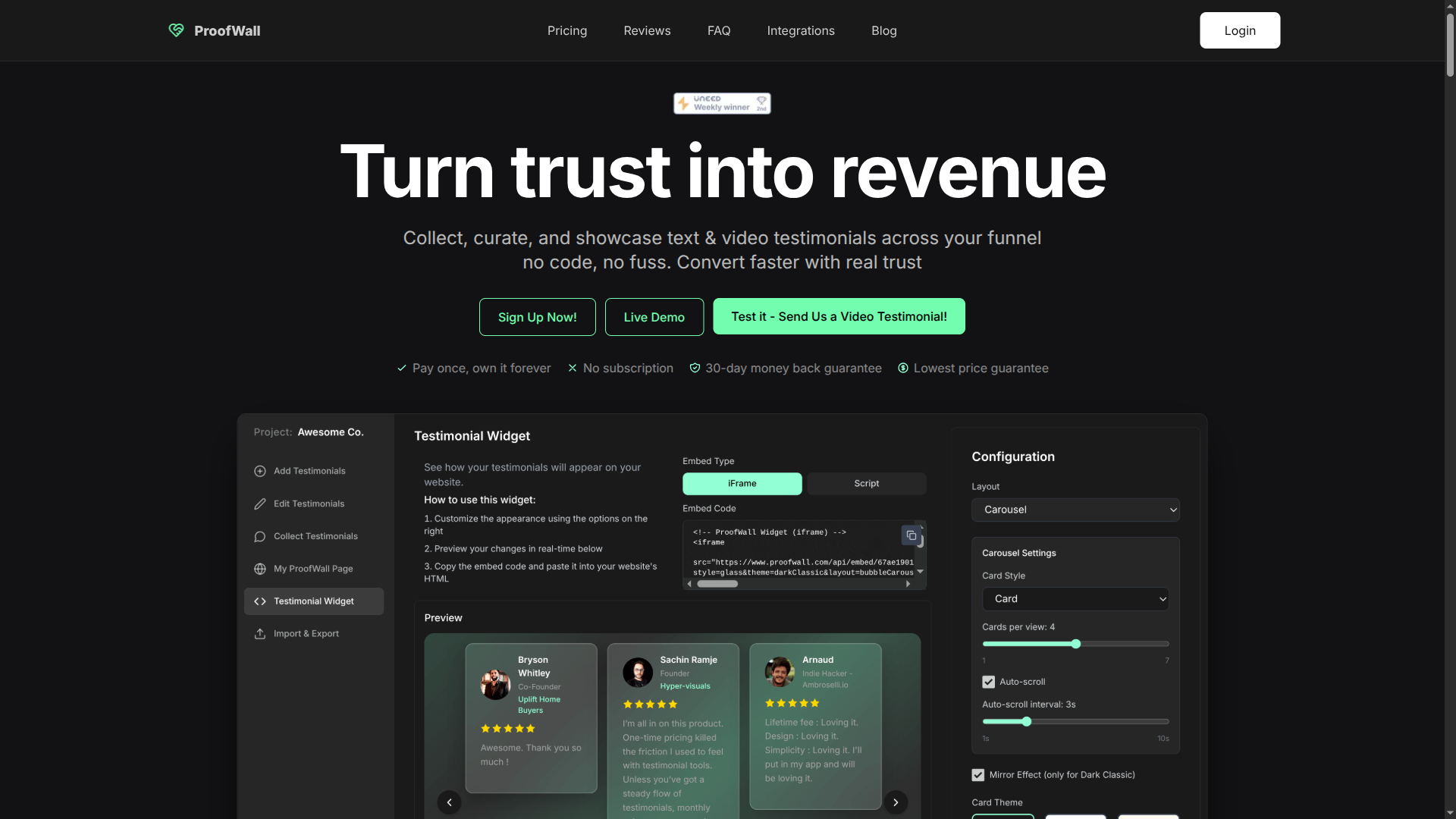
ProofWall is a focused, easy-to-use platform for collecting testimonials and turning them into clean, customizable social-proof widgets you can drop onto any site. You share a collection link, gather text and video testimonials, approve the best ones, and embed a wall of love, carousel, or single quote widget in minutes.
It is especially useful if you want a direct path from "happy customer" to "proof on the page" without building a custom testimonial system or installing a bulky plugin. The workflow is intentionally simple: collect, curate, customize, embed.
Where ProofWall stands out is the balance of simplicity and control. You get brandable widgets, text and video support, no-code embeds, and a dashboard that is easy for non-technical teams to use. It is a strong fit for founders and marketers who care about speed, page design, and keeping testimonials organized in one place.
- Best for: Founders, marketers, and small teams who want a fast, no-code way to collect and display testimonials with clean, customizable widgets.
- Key strengths: Simple setup, flexible embeds, strong fit for WordPress and marketing sites, clean widget design, text and video collection.
- Consider if: You want social proof live quickly and do not want a complex enterprise review platform.
- Potential limitation: If you need a large marketplace of integrations or highly specialized video production services, compare it with more mature or video-first tools below.
Ready to start collecting testimonials? Try ProofWall free today.
2. Senja

Senja is one of the most popular Testimonial.to alternatives, especially among creators, SaaS founders, and marketers who care about polished design. It combines testimonial collection, widget creation, wall of love pages, social proof images, and imports from external sources.
The product feels designed for teams that want social proof to look good across channels, not just on a website. You can collect testimonials, organize them, turn them into widgets, and repurpose them as social media assets.
- Best for: Teams that want lots of widget variety and design options at an accessible price point.
- Key strengths: Attractive widgets, social image generation, text and video collection, public wall of love pages, testimonial imports.
- Consider if: You want a design-forward testimonial platform with a broad set of presentation formats.
- Potential limitation: If you only need a lightweight embed for a few website sections, the broader feature set may be more than you need.
3. Trustmary

Trustmary sits closer to the review and conversion optimization side of the market. Instead of only helping you collect testimonials, it also focuses on gathering reviews, importing existing reviews, embedding them on your site, and measuring how social proof affects conversions.
That makes it useful for businesses that already treat testimonials as part of a broader growth system. If you want to test which proof widgets perform best, collect reviews at scale, and connect testimonials to lead generation, Trustmary is worth evaluating.
- Best for: Marketing teams focused on measuring and optimizing the conversion impact of social proof.
- Key strengths: Review imports, conversion-focused widgets, lead generation forms, A/B testing features, broader review management.
- Consider if: You want testimonials and review collection tied directly to conversion experiments.
- Potential limitation: It can be more platform than a small team needs if your goal is simply publishing a testimonial wall.
4. Famewall
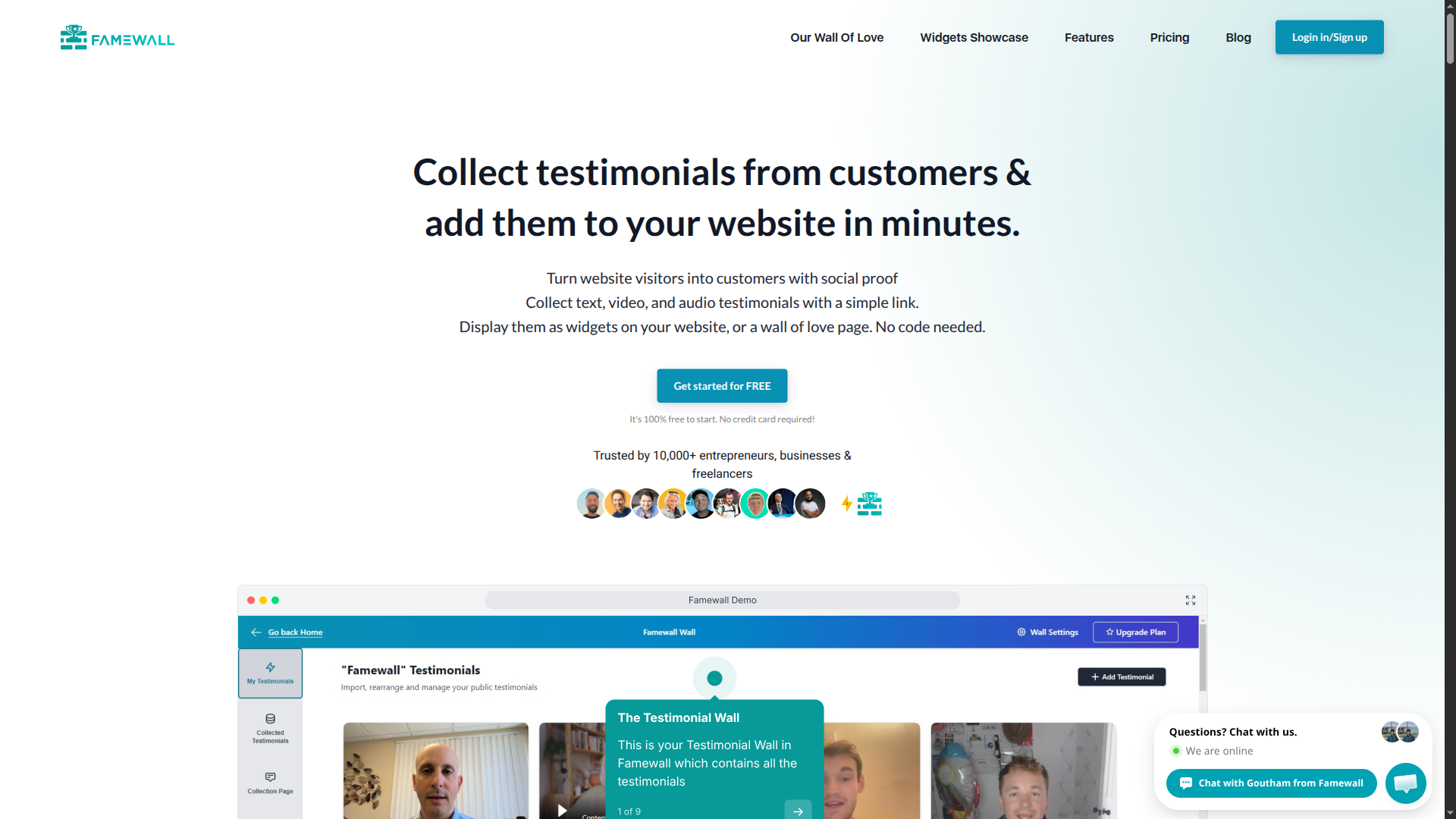
Famewall is a simple testimonial and wall of love tool that works well for creators, indie hackers, bootstrapped SaaS products, and small businesses. It helps you collect testimonials through a link, import praise from places like social media, and publish a clean wall of love or embedded widget.
Its appeal is speed. You do not need a heavy setup process or a complicated review management system. If you already have customer praise scattered across social posts, comments, and direct messages, Famewall can help turn that proof into a visible asset.
- Best for: Creators and small businesses who want to aggregate praise from social media alongside collected testimonials.
- Key strengths: Simple wall of love creation, social proof imports, creator-friendly setup, quick publishing.
- Consider if: You want to turn scattered customer praise into a public proof page without overcomplicating the workflow.
- Potential limitation: Larger teams may want deeper collaboration, analytics, or review management features.
5. Shoutout

Shoutout focuses on the core testimonial workflow: collect responses, organize them, and display them with widgets. It supports text and video testimonials and is aimed at teams that want a clean, practical way to manage social proof without building their own CMS for quotes.
It is a good option if you want something more specialized than a generic form builder but do not need a large review platform. The workflow is familiar: create a request, collect responses, tag or approve them, then embed the strongest proof where it matters.
- Best for: Businesses that want a straightforward collect-and-embed workflow with solid customization.
- Key strengths: Text and video collection, customizable widgets, tagging and organization, clean embed workflow.
- Consider if: You want a direct alternative to Testimonial.to with a similar focus on collection and display.
- Potential limitation: It may not be as widely known as some competitors, so compare support, roadmap, and integrations before committing.
6. Vocal Video
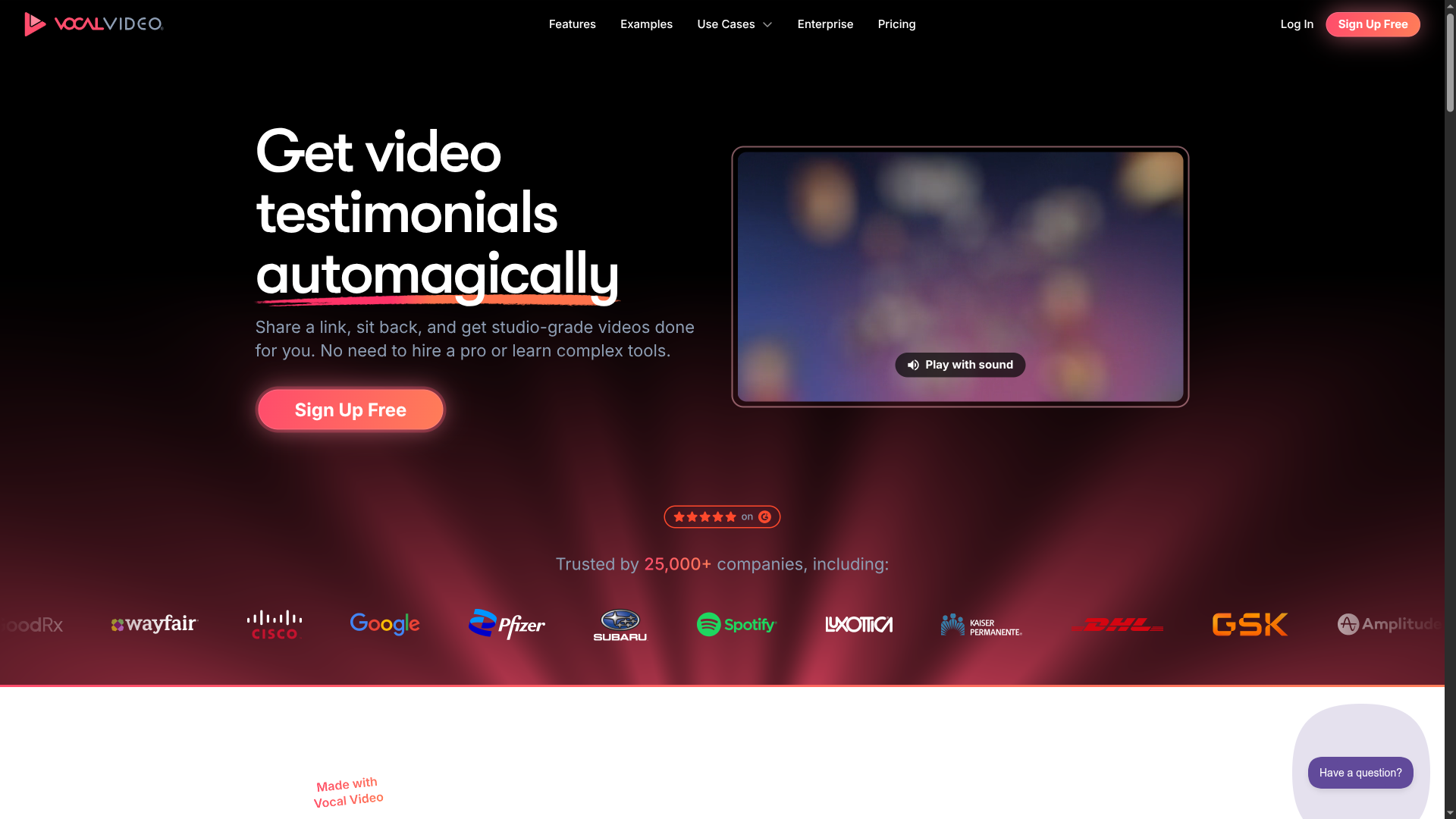
Vocal Video is built for teams that take video testimonials seriously. It helps you guide customers through recording, then turns those responses into branded video assets with less manual editing work. Features can include guided prompts, automatic editing, captions, transcripts, and shareable video galleries.
This is different from a simple testimonial wall. Vocal Video is closer to a lightweight customer video production workflow. If your sales team needs polished customer stories for landing pages, campaigns, webinars, or enterprise sales decks, it can be a strong fit.
- Best for: Teams that prioritize high-quality, professionally styled video testimonials.
- Key strengths: Guided video collection, branded video outputs, captions and transcripts, strong fit for customer stories.
- Consider if: Video proof is central to your funnel and you want a more polished result than raw uploads.
- Potential limitation: If you mostly need simple text quotes and fast website widgets, a video-first platform may add unnecessary complexity.
7. Boast
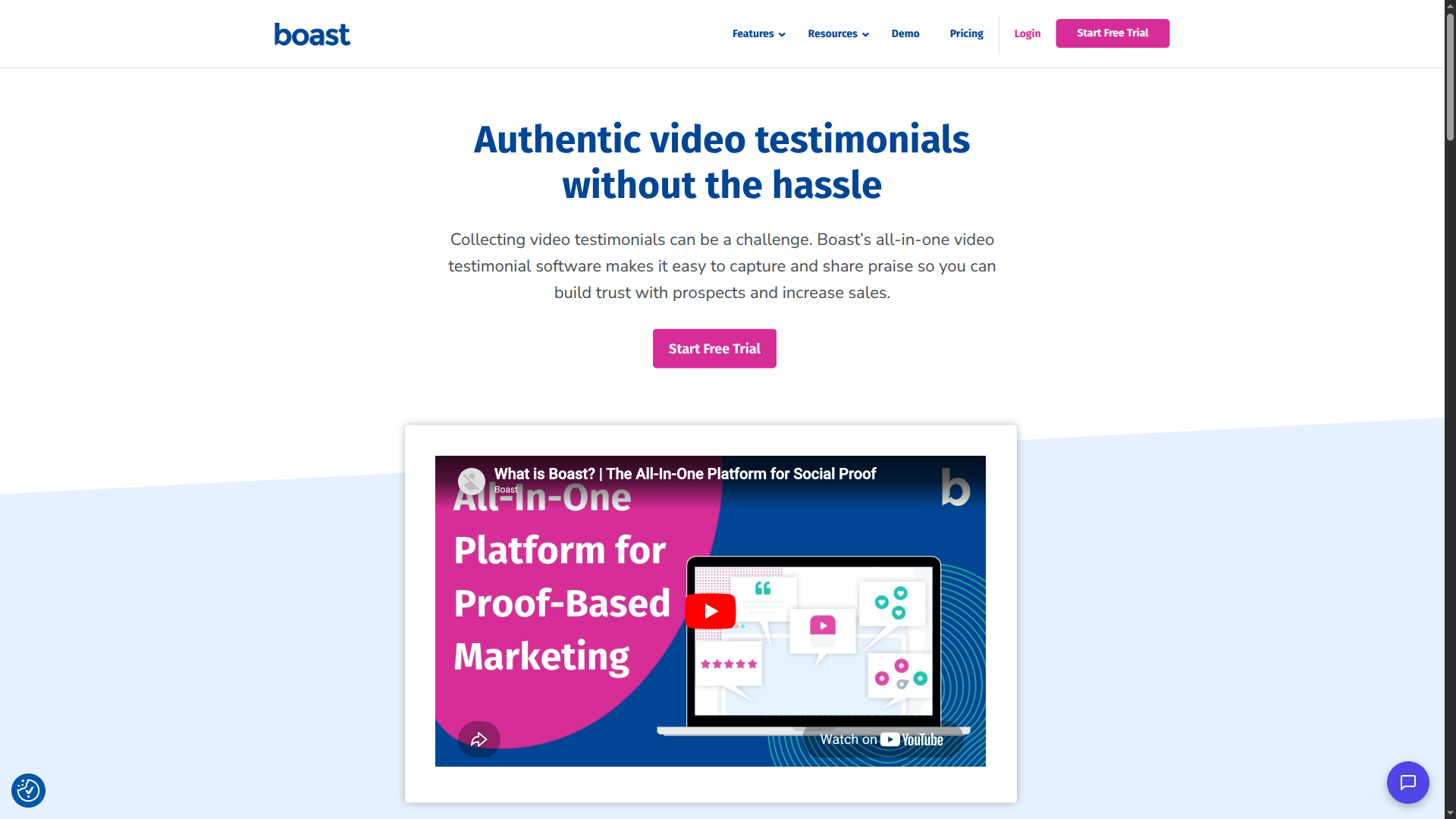
Boast is another strong option for video, audio, and text testimonial collection. It is often used by service businesses, agencies, educators, and companies that want structured forms rather than a lightweight wall of love only.
The main difference is workflow depth. Boast can be useful when you want to ask specific questions, collect richer responses, and manage submissions in a more process-oriented way. If your testimonial requests need to fit into a repeatable customer success process, it deserves a look.
- Best for: Businesses that need flexible, form-based collection with a video and audio focus.
- Key strengths: Custom forms, video/audio collection, structured workflows, embeddable displays.
- Consider if: You need more control over the questions customers answer and the format of submissions.
- Potential limitation: It may feel heavier than necessary if your priority is a fast, attractive testimonial widget.
8. VideoAsk (by Typeform)
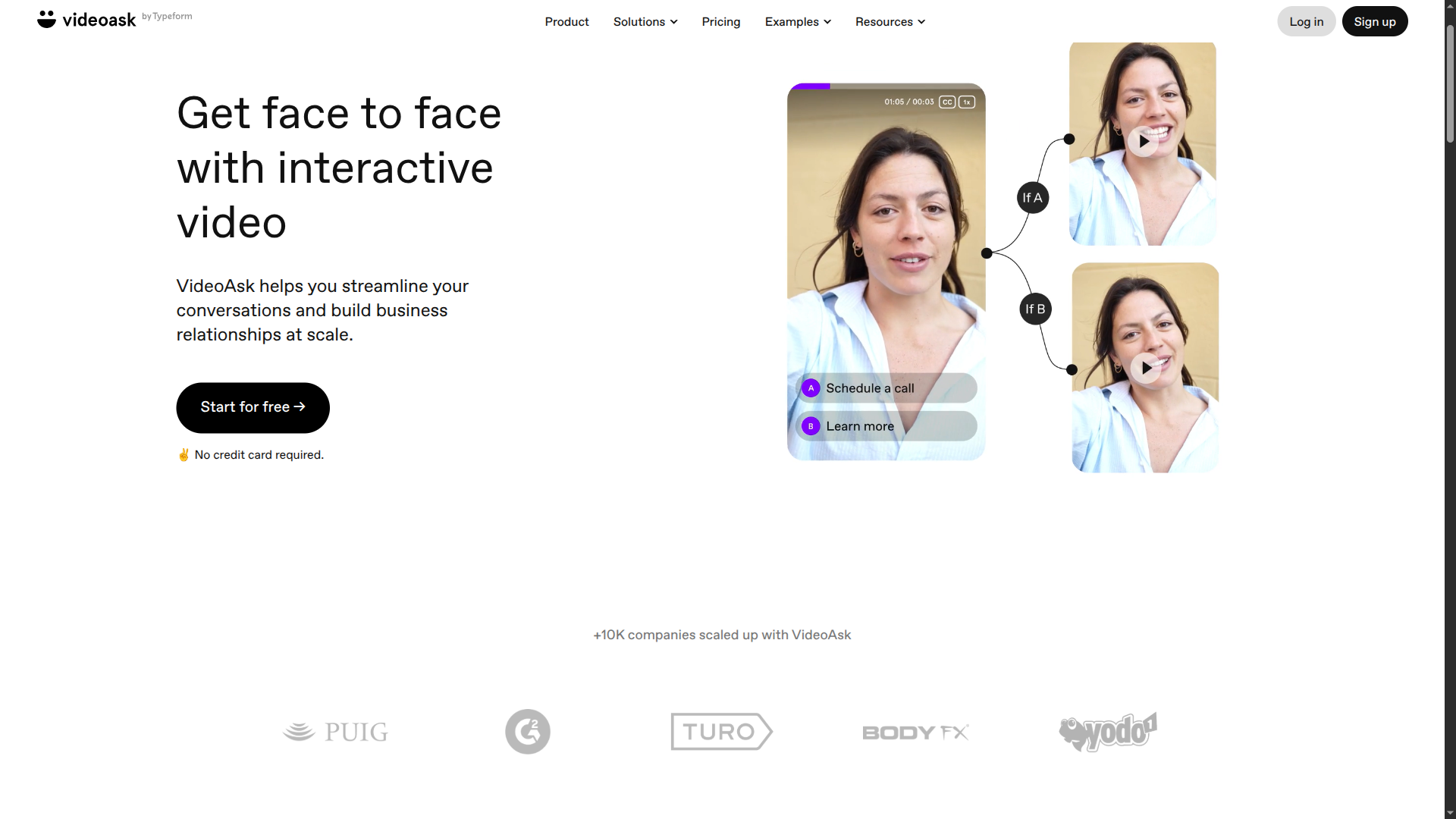
VideoAsk is not only a testimonial tool. It is a conversational video platform that lets you ask questions with video prompts and collect video, audio, or text responses. That makes it useful for testimonials, but also for lead qualification, customer feedback, hiring, onboarding, and asynchronous conversations.
For testimonial collection, the advantage is the interaction style. Customers respond to a face-to-face prompt rather than a static form, which can make the experience feel more personal. It is especially useful when you want customers to tell a short story in their own words.
- Best for: Teams that want interactive, conversational video collection and tight Typeform integration.
- Key strengths: Conversational video prompts, flexible response types, broad integrations through Typeform, polished UX.
- Consider if: You want testimonial collection to feel like a personal conversation instead of a form.
- Potential limitation: Because it is not purpose-built only for testimonials, you may need additional tools or manual work to turn responses into testimonial walls and website widgets.
9. Endorsal
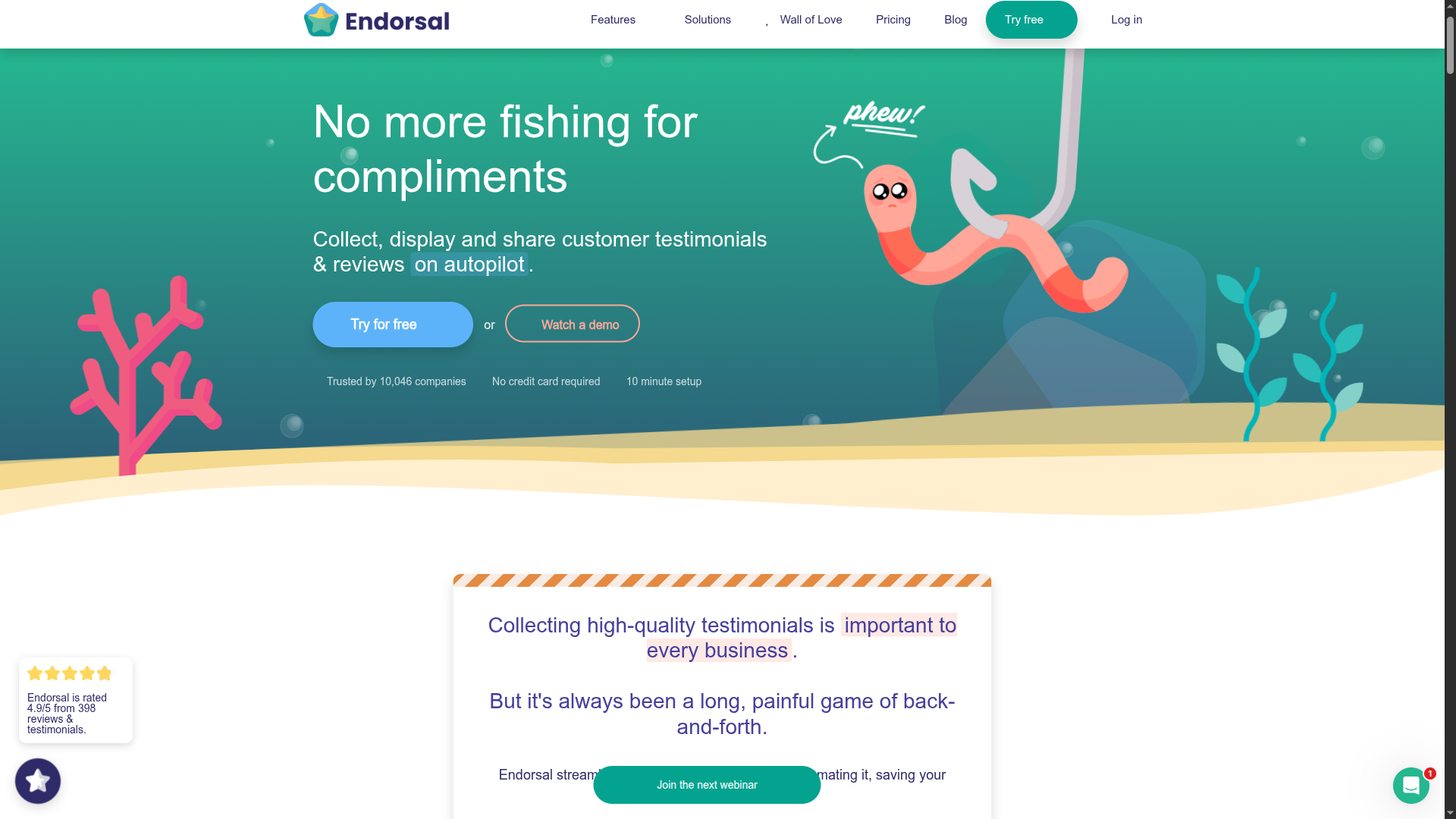
Endorsal focuses on automating testimonial requests and displaying the results through branded widgets. The idea is to reduce the amount of manual chasing required to collect customer proof. Instead of remembering to follow up with every happy customer, you can build testimonial requests into a repeatable workflow.
This can be valuable for service businesses, ecommerce stores, agencies, and SaaS teams that already know when a customer has reached a success milestone. Trigger the request at the right moment, collect the proof, approve it, and display it on your site.
- Best for: Businesses that want to automate testimonial requests and reduce manual follow-up.
- Key strengths: Automated requests, branded collection forms, embeddable widgets, useful for repeatable customer journeys.
- Consider if: Your biggest bottleneck is not display design, but remembering to ask at the right time.
- Potential limitation: Check current product activity, integrations, and support responsiveness before choosing it as your long-term testimonial system.
10. Testimonial Hero
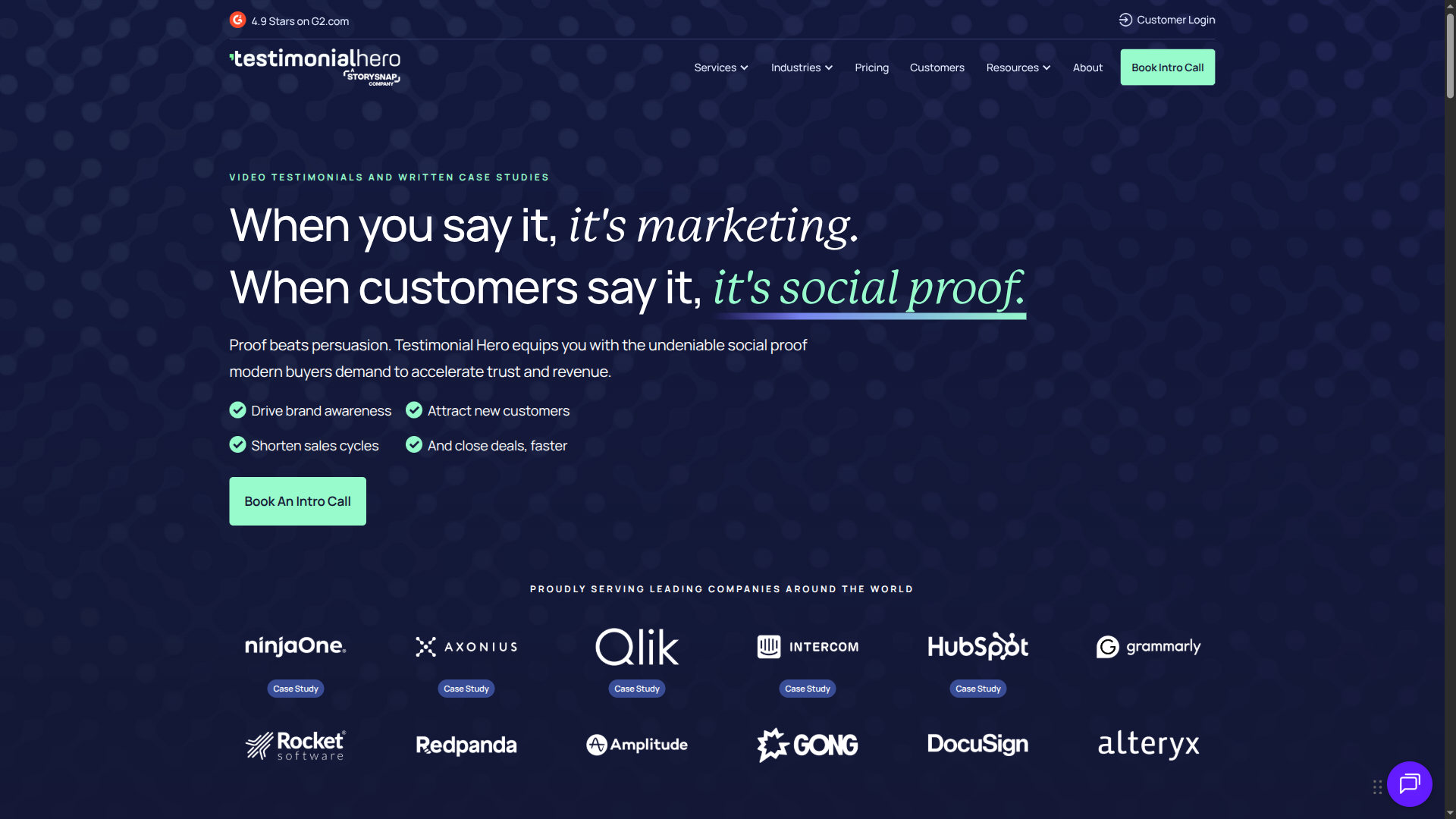
Testimonial Hero is different from most tools on this list because it is primarily a done-for-you service, not a self-serve testimonial widget platform. The company helps plan, record, edit, and deliver professional customer testimonial videos.
That makes it a strong option for B2B companies selling higher-ticket products, especially when a single polished customer story can support sales enablement, homepage positioning, paid campaigns, and enterprise deal cycles. You are paying for production quality and process, not just software.
- Best for: Companies with the budget for premium, professionally produced video testimonials.
- Key strengths: Professional production, customer interview process, polished video assets, strong sales enablement use case.
- Consider if: You want flagship customer stories that look more like case study videos than casual testimonial uploads.
- Potential limitation: It is not the right fit if you need a low-cost self-serve tool for collecting lots of lightweight testimonials.
Quick Comparison: Which Alternative Fits Your Use Case?
| If you need... | Start with... | Why |
|---|---|---|
| A fast no-code wall of love for your website | ProofWall | Simple collection, clean embeds, and customizable widgets |
| The most polished social proof designs | Senja | Strong visual presentation and widget variety |
| Conversion testing around reviews and testimonials | Trustmary | More emphasis on analytics, review imports, and optimization |
| A simple creator-friendly praise wall | Famewall | Easy way to collect and publish social proof quickly |
| A direct collect-and-display testimonial workflow | Shoutout | Focused on testimonial collection and widget publishing |
| Professional-looking video testimonials | Vocal Video | Built around guided video collection and branded outputs |
| Structured testimonial forms | Boast | Stronger form-based collection for video, audio, and text |
| Conversational video prompts | VideoAsk | Personal, interactive video collection experience |
| Automated testimonial requests | Endorsal | Helps reduce manual follow-up |
| Premium customer story videos | Testimonial Hero | Done-for-you production quality |
How to Choose the Right One
The easiest way to choose is to start with your bottleneck. Most teams do not have a testimonial problem in the abstract. They have one of five specific problems.
If you are not collecting enough testimonials
Choose a tool that makes requesting testimonials easy. Look for simple forms, shareable links, reminders, and automation. ProofWall, Famewall, Shoutout, Boast, and Endorsal are good places to compare.
The key question is: Will our team actually use this every week? A slightly simpler tool that gets used consistently will outperform a complex tool that sits untouched.
If your testimonials look bad on your website
Focus on display customization. You want widgets that match your brand, support the layouts you need, and work cleanly across desktop and mobile. ProofWall and Senja are strong options here.
Pay attention to the small details: avatar sizes, card spacing, dark mode, star ratings, logos, and whether the widget feels native to your page.
If you need better video proof
Start with Vocal Video, Boast, VideoAsk, or Testimonial Hero. They each approach video differently:
- Vocal Video is good for guided video testimonials and branded outputs.
- Boast works well for structured video/audio collection forms.
- VideoAsk is best for conversational video prompts.
- Testimonial Hero is best for premium produced customer stories.
If you only need occasional video alongside text testimonials, ProofWall or Senja may be enough.
If you already have reviews elsewhere
Look at importing and aggregation. Trustmary, Senja, and Famewall are useful if much of your proof already exists on review sites or social platforms.
This is important because most businesses underestimate how much proof they already have. Before asking for new testimonials, audit your existing praise: emails, support chats, social posts, review sites, LinkedIn comments, and customer calls.
If you need enterprise-grade sales assets
If testimonials support enterprise sales, product marketing, or account-based marketing, you may need polished customer stories rather than a simple widget. Testimonial Hero and Vocal Video are better suited for that higher-production workflow.
In that case, prioritize story quality over volume. One strong video from the right customer can be more persuasive than twenty generic quotes.
Migration Checklist: Moving Away from Testimonial.to
If you are already using Testimonial.to, do not switch tools casually. A messy migration can break embeds, lose attribution, or remove proof from high-converting pages. Use this checklist before moving:
- Export or copy your existing testimonials. Preserve names, titles, companies, avatars, ratings, videos, permissions, and original submission dates where possible.
- Map where testimonials are currently displayed. Check your homepage, pricing page, landing pages, product pages, blog posts, emails, and sales decks.
- Prioritize your highest-impact placements. Rebuild widgets for pages that drive conversions first.
- Recreate tags or categories. If you sort testimonials by use case, industry, persona, or product feature, rebuild that structure in the new tool.
- Check consent and usage rights. Make sure you still have permission to display each quote, photo, logo, or video.
- Replace embeds carefully. Update one page at a time and verify desktop and mobile rendering.
- Measure before and after. Track conversion rate, engagement, page speed, and click behavior so you know whether the switch helped.
The goal is not just to move testimonials. The goal is to improve how social proof supports your funnel.
Recommended Picks by Business Type
Here are practical recommendations if you still feel stuck:
- Bootstrapped SaaS: ProofWall, Senja, Famewall
- Agencies and service businesses: ProofWall, Boast, Endorsal
- Creators and course sellers: Senja, Famewall, VideoAsk
- Conversion-focused marketing teams: Trustmary, ProofWall, Senja
- Video-heavy B2B teams: Vocal Video, VideoAsk, Testimonial Hero
- Enterprise sales teams: Testimonial Hero, Vocal Video, Trustmary
Pricing and features change often, so always confirm the current details on each provider's site before committing.
Frequently Asked Questions
What is the best Testimonial.to alternative overall?+
For most small teams that want a fast, practical way to collect and display testimonials, ProofWall is the best place to start. It focuses on the core workflow: collect testimonials, approve them, customize widgets, and embed social proof on your site without code.
If you need highly polished social image creation, compare Senja. If you need conversion testing and review management, compare Trustmary. If you need premium video production, compare Testimonial Hero.
What is the best free Testimonial.to alternative?+
Free plans change often, so check each provider's current pricing page. Senja is often attractive to teams looking for a generous starting point, while ProofWall is worth considering if you want a simple path to clean website widgets without overcomplicating your setup.
The better question is not only "What is free?" but "What will still work when we have 50 or 100 testimonials?"
Which tool is best for video testimonials?+
If video is your main focus, compare Vocal Video, Boast, VideoAsk, and Testimonial Hero.
Choose Vocal Video for guided branded video testimonials, Boast for structured video/audio forms, VideoAsk for conversational video prompts, and Testimonial Hero for professional done-for-you customer stories.
Which tool is best for a wall of love?+
ProofWall, Senja, and Famewall are all strong choices for wall of love pages and embedded testimonial displays. Choose based on how much customization you need, how you collect testimonials, and whether you want text, video, or social media imports.
Should I use testimonials or reviews?+
Use both if you can. Reviews are often better for third-party credibility and search visibility. Testimonials are better for curated messaging, objection handling, and placing specific proof near conversion points.
For example, a Google review may build general trust, while a homepage testimonial can directly address a specific concern like "Will this work for a small team?"
Where should I display testimonials?+
The highest-impact placements are usually:
- Homepage hero or section below the hero
- Pricing page
- Product feature pages
- Checkout or signup flow
- Landing pages
- Case study pages
- Email campaigns
- Sales decks
Match the testimonial to the page. A pricing page needs proof about value and ROI. A feature page needs proof about that feature. A homepage needs broader credibility.
Conclusion
Testimonial.to is a good tool, but it is far from your only option. The testimonial software market has matured, and the right choice now depends on your workflow.
If you want a fast, no-code way to collect testimonials and showcase them with clean, customizable widgets, start with ProofWall. If design variety is your top priority, compare Senja. If you want conversion optimization and review management, look at Trustmary. If video is central to your sales process, compare Vocal Video, Boast, VideoAsk, and Testimonial Hero.
If you want the simplest path to collecting testimonials and showcasing them with clean, customizable widgets, give ProofWall a try.